
Description
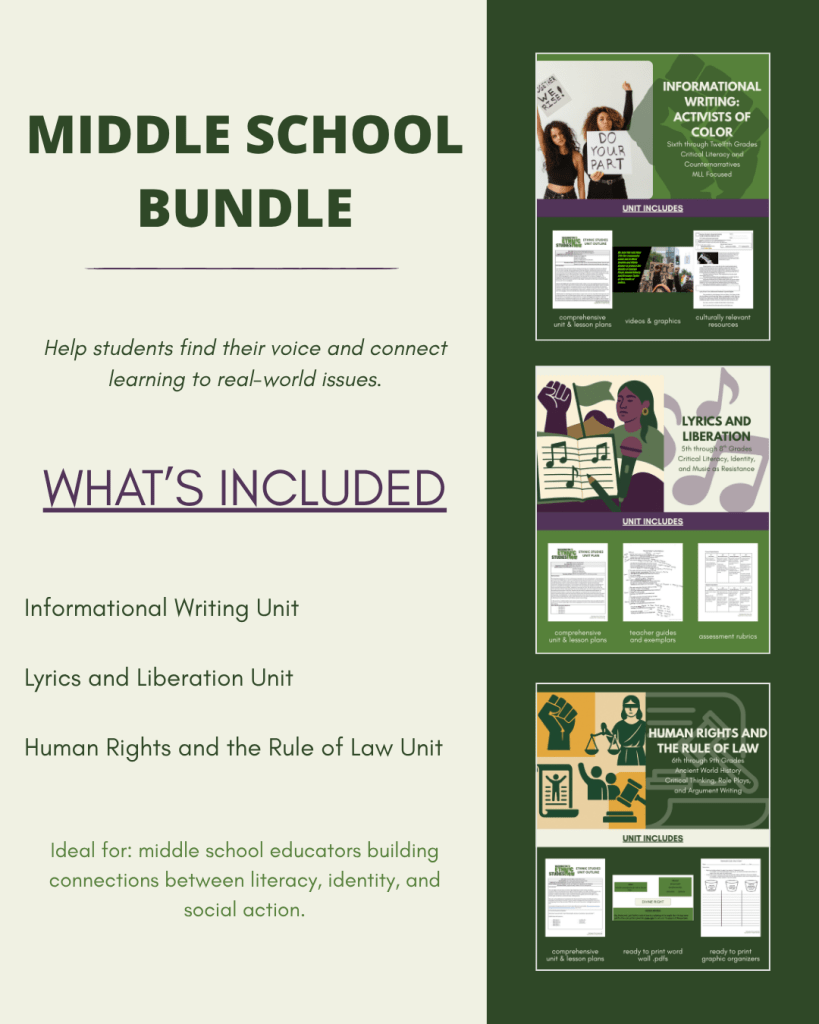
What Makes a Good Law? shifts the classroom from a place of compliance to a place of critical inquiry. This lesson is a cornerstone of the Human Rights and the Rule of Law unit, challenging students to reflect on their personal values and the systemic impact of legal frameworks.
The lesson centers on a high-energy simulation and a Philosophical Corners activity. Students are presented with complex scenarios—including a “twist” that changes the power dynamics—and must physically move to corners of the room that represent their stance. This isn’t just a debate; it’s a masterclass in Action and Reflection, where students are encouraged to change their minds and their physical positions as they hear stronger, more equitable arguments from their peers.
Through the use of a structured graphic organizer, students practice the essential ELA and Social Studies skills of drafting claims, identifying counterclaims, and providing rebuttals, all while centering the WAESN framework of justice and liberation.
What’s Included
-
Complete 1-period lesson plan with detailed simulation scripts and facilitation guides.
-
L4.1 PowerPoint Presentation to guide the scenarios and philosophical prompts.
-
L4.2 Claim and Counterclaim Graphic Organizer to scaffold student writing and argumentation.
-
Philosophical Corner Posters for classroom setup and physical movement.
-
Exit Ticket designed for deep reflection on the purpose and morality of laws.
-
Alignment with WAESN Elements of Liberation and C3 Framework for Civics and Government.
Why Educators Use This Lesson
-
Kinesthetic Learning: Uses physical movement to represent intellectual positions, keeping middle schoolers engaged and focused.
-
Builds Argumentation Skills: Provides a low-stakes, high-interest environment to practice the rigorous work of counterclaims and rebuttals.
-
Centers Student Agency: Values the students’ lived experiences and personal ethics as valid starting points for legal analysis.
-
Critiques Power Dynamics: The “twist” in the simulation forces students to see how laws can shift from protective to oppressive depending on who holds the power.
-
Collaborative Inquiry: Moves away from teacher-led lectures and toward a student-driven negotiation of justice.
This lesson gives your students the gavel and asks them: is the law fair, or is it just a rule?



Reviews
There are no reviews yet.