Description
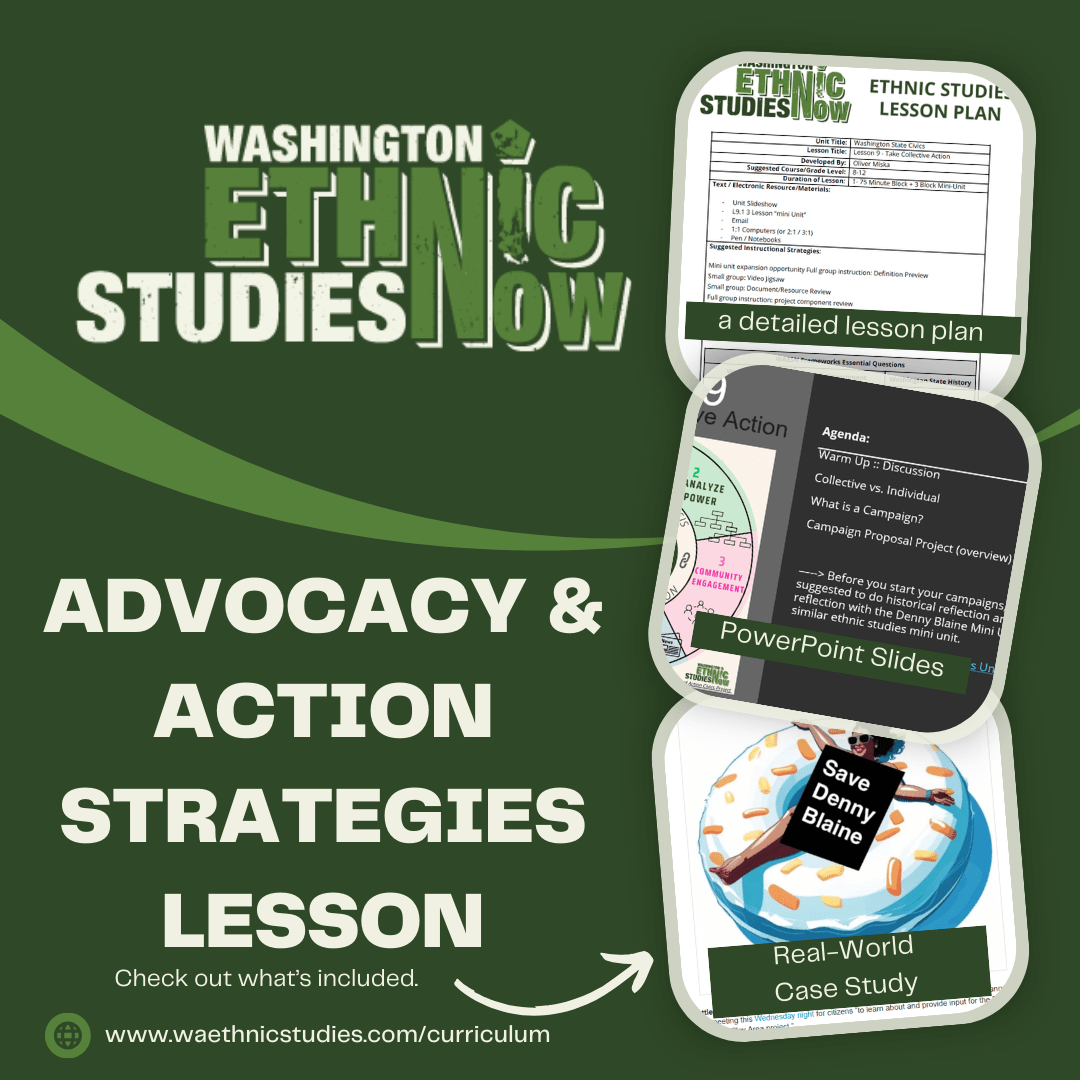
Advocacy & Action Strategies provides the tactical depth needed to execute a successful civic campaign. In this lesson, students move beyond “what” they want to change and focus on “how” to make it happen within the specific constraints and opportunities of the Washington State government. This lesson centers on the Agency and Action & Reflection elements of the WAESN framework, giving students a menu of proven methods to disrupt systemic injustice.
Designed for a 75-minute block, the lesson begins with a high-level review of diverse action strategies. The core of the session is a Testimony Jigsaw, where students watch and analyze videos of real people testifying before legislative committees in Olympia. They evaluate the tone, evidence, and impact of these speakers. Following this, campaign teams move into a strategic work session, using their unit slideshow tools to select the best Action Strategy for their proposal—whether that be organized testimony, a letter-writing campaign, or community mobilization.
What’s Included
-
Detailed 75-minute lesson plan with protocols for full-group instruction, jigsaw activities, and campaign work time.
-
Unit Slideshow (Slides 72-84) featuring links to real-world testimony videos and advocacy strategy menus.
-
Testimony Analysis Protocol—a guide for students to evaluate the effectiveness of public comments in legislative hearings.
-
Action Strategy Menu featuring links and examples of different types of civic engagement (Public Hearing, Lobby Day, Direct Action).
-
Summative Exit Ticket where students synthesize their learning by watching a concluding video and applying a strategy to their specific campaign.
-
Alignment with WAESN Elements of Liberation (Agency & Action/Reflection) and C3 Framework for Social Studies (Taking Informed Action).
Why Educators Use This Lesson
-
Demystifies the Legislative Process: By watching real testimony, students realize that the people speaking in Olympia are community members just like them.
-
Strategic Versatility: Teaches students that advocacy isn’t one size fits all—different goals require different tactics.
-
High-Stakes Observation: Analyzing real-world examples helps students prepare for their own potential roles as future witnesses in public hearings.
-
Campaign Refinement: Gives student groups dedicated time to transition from the research phase to the planning phase of their final proposals.
-
Empowers Resistance: Explicitly connects classroom learning to the historical and contemporary ways that marginalized communities have fought for and won legislative change.
This is the lesson that teaches students how to stand in front of the people in power and demand to be heard.



Reviews
There are no reviews yet.