
What The Boys Teaches Us About Pro-Social Shame in K–12 Education
Part 2
Welcome to Part 2 of Homelander in the Age of MAGA about the harmful effects of zero-shame initiatives. In Part 1, I made the connection between Homelander and these types of initiatives that allow mostly privileged students to act with impunity because we’ve become so obsessed with this idea that students should never feel shame or guilt despite evolutionary psychology defending the need for pro-social shame. In Part 2, I am going to use the frameworks provided in Part 1 to show concrete, real-life examples of these zero-shame initiatives in play. I will also discuss restorative justice, currently one of the biggest education buzzwords, because we do it wrong! Pro-social shame is the cornerstone of restorative justice.
Let’s Eliminate Toxic Shame, Not Accountability
I want to start this section as clear as possible: eliminating toxic shame is a no-brainer. All toxic behavior should be eliminated from school and classroom environments, from shame, to restricting bathroom breaks, to dress codes. Yes. Period. Schools have long used humiliation, exclusion, and identity-based shaming as tools of control, especially against marginalized students.
For example, the middle-school I taught at had an end-of-year ice cream social that excluded students who were absent from, “misbehaved” during, or opted out of taking standardized tests. We know that attendance-based discipline is ableist and biased against low-income families, “misbehaving” during days-long tests is developmentally appropriate for most ages and ableist in a lot of cases, and that standardized tests are biased against families of color, multilingual families, and low-income families (Au, 2016). Shaming and excluding students for these things is an example of toxic shame.
The trouble arises when educators and policymakers start treating all negative feelings experienced by students as harmful or toxic.
I get it. Many of us think of our students as our children. We often take on the role of protector and want to shield them from harm, but there’s a difference between protecting and enabling. Zero shame quickly defaults to zero accountability when we try to protect students from deserved embarrassment, guilt, or discomfort caused by their negative actions instead of holding space for them to sit with those feelings, repair harm to alleviate those feelings, and grow from those experiences.
Enabling caused by zero-shame initiatives becomes even more acute when we take into account the ongoing marginalization of certain groups of students that work to further privilege other groups. Marginalized students are shamed daily through racist curriculum, racist discipline practices, surveillance, tracking, language policing, dress code, deficit narratives, and the list goes on (An, 2020; Castro-Gill, 2025; Ladson-Billings, 1998; Martin, 2019; Robbins, 2018). Yet, when implementing zero-shame initiatives in schools, these things are rarely addressed as sources of shame. The question then becomes, “Who is made to carry shame, and for what purpose?”
Privileged students, however, who don’t experience shame from any of those sources, experience zero-shame initiatives as zero discomfort, or at least an expectation of zero discomfort, even when they do harm. Therefore, when an attempt is made to hold them accountable for harm they’ve committed, they see it as an attack. This played out for me in real life recently.
Who is made to carry shame, and for what purpose?
At a professional development session I was leading, I talked about how teachers need to be held accountable for their actions. A white woman spoke up saying, “When I hear the word, ‘accountability,’ I hear punishment.” I was so shocked to hear that. I’ve always thought of accountability as an act of love, but the consensus in the room of mostly white women was that accountability felt like a personal attack.
My students used to call me a “mom teacher.” They explained that I was strict and loving and didn’t put up with any of their BS. My response was, “I love you, and I don’t want you to go out into the world acting like fools. If I don’t hold you accountable for your actions, it means I don’t care how you behave outside of this classroom, and that’s not love.” My students valued this understanding of accountability and understood that feeling discomfort after causing harm wasn’t a moral or personal failing that harmed them.
This different way of understanding accountability plays out with Homelander in The Boys. Homelander and his white peers literally get away with murder, but the supes who are queer, Black, disabled, or female are penalized by the system—which is really Homelander’s hegemony—the moment they try to hold Homelander accountable or step out of line. Homelander saw accountability as an attack. Additionally, the marginalized supes’ ability to avoid shame is diminished with each intersection. It’s not lost on me that Homelander’s primary supe adversary who eventually defeats him is a white, Christian woman whose only known marginalized identity is gender, leaving her with zero intersections.
Who is made to carry shame, and for what purpose?
Reduce toxic shame and support students in metabolizing pro-social shame in a way that is healthy and promotes resolution and personal growth. That is the intent, and not always the result, of restorative justice initiatives in schools
Restorative Justice and Moral Friction
Restorative justice (RJ) has been hyped up in K–12 education as a solution to punitive discipline that disproportionately and negatively impacts students of color, especially Black students. When I was teaching, my school held a single professional development (PD) dedicated to RJ led by the assistant principal (AP), Dr. Marcus Pimpleton. It was actually a really good PD. Marcus invited a group of students who had a real conflict to join a circle and resolve the conflict. We were observers as Marcus explained to us each step and why it was important. The circle included the student who caused harm and all witnesses to the harm who wanted to be part of the conversation. It was a profound learning experience for me. The student who caused harm was clearly uncomfortable, and the students who experienced the harm didn’t hold back, but they were also respectful and supportive of the student who caused harm. The goal, you see, wasn’t to shame that student, it was to repair the harm they experienced and repair the shame and guilt the student felt for causing the harm. That’s the key to restoration; the entire community, including the offender, can move forward together in a good way. Trust is repaired, and the community can heal.
After that one-off PD that many educators worked through (teachers can be the worst students), the principal declared that our school was now an RJ school. Unfortunately, it was only in name. Not long after this PD, I had an incident in my classroom that I thought needed to be solved by our supposed new RJ practices. It was winter, and it was snowing lightly. My classroom had a wall of windows. A Black female student was at the window with some of her peers before the bell rang watching the snow excitedly. A Black male student came into the room, walked directly to her and smacked her hard upside the back of her head. There was no warning, no discussion. Just bam. As directed, I sent them to the AP to repair harm.
By this time, Marcus had left the school, and the current AP had not yet been hired to attend his training. I expected her to come back with the students and have a RJ circle in my classroom. After all, the other students in the room witnessed this act and were harmed by it as well. Instead, she sent both students back to class. I asked what happened, and the female student shared that she made them both apologize to one another! I was appalled and infuriated. Why did the female student need to apologize? She was forced to repair harm that was done to her. This was not RJ. I don’t even have a word for it other than equality, and equality is not always justice.

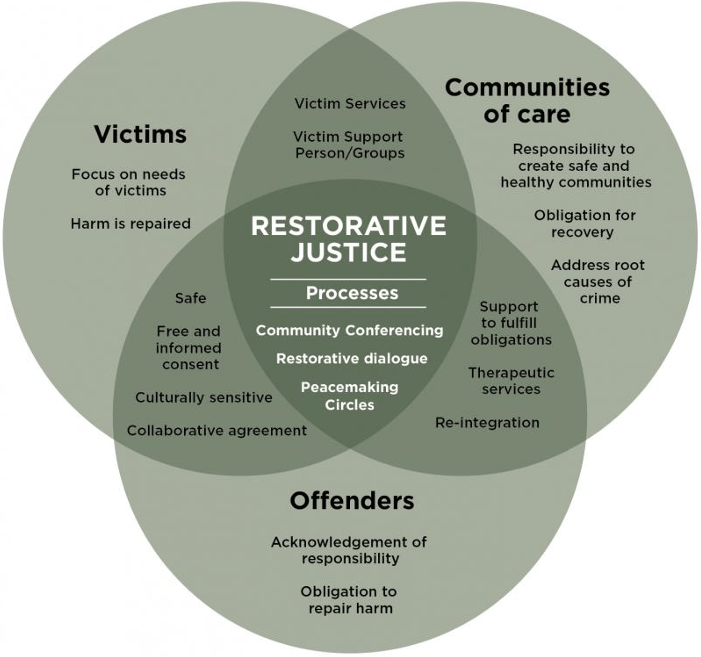
Restorative Justice is intended to be a communal act to repair harm for the entire community.
Image source: https://tribaljustice.org/wp-content/uploads/2024/06/2024-March-Peacemaking-Webinar-FINAL.pdf
RJ processes, as practiced by many Indigenous Tribes since time immemorial, require intentional moral friction, or pro-social shame. In traditional punitive justice, the perpetrator of harm is processed separately from the people and communities they harmed. It’s transactional and allows for the perpetrator to use cognitive distortions to minimize their impact while victims are often left with a resolution they had no input on that does nothing for them or their pain. When facing and listening to the victims of harm, both the perpetrators and the victims hold the tension of moral friction—the perpetrator experiences moral friction between wanting to minimize their impact and being faced with the reality of it, and the victim(s) experience the moral friction of being angry, needing a suitable consequence, and wanting repair (Birkbeck & Smith, 2022; Carson, n.d.). My students and their classmates received none of this, and it allowed the male student to act with impunity, teaching him and his male peers that violence against women and girls would go unpunished. The community was harmed further rather than restored.
Who is made to carry shame, and for what purpose?
The true challenge is in doing RJ right. It can’t be a free-for-all shaming session against the person who caused harm, and it can’t be what happened with my students. If you and your school are looking into RJ, please consult Indigenous leaders. There are many organizations who offer PD on RJ that are led by white folks. I urge you to avoid them and start with Tribal Access to Justice Innovation or contact your local treaty tribe to inquire about RJ resources.
If your school claims to practice RJ, ask yourself the following questions to help determine if the practice is actually RJ:
Is the student being told they are bad, or that their action caused harm?
Is the discomfort connected to repair, or is it just punishment?
Is the student with more power being protected from discomfort while marginalized students are expected to absorb harm?
Are we teaching students that all negative feelings are unsafe, or that some negative feelings are necessary signals?
Does our accountability process restore the community, or merely soothe the people directly involved?
Back to Homelander in the Age of MAGA
Ultimately, Homelander remains the most potent metaphor for what happens when we remove every boundary in the name of comfort. He is a tyrant not just because of his powers, but because everyone around him—terrified of causing him even a moment of friction—cleared the path for his cruelty. If we confuse comfort with harmony, we fail to offer the very thing our students need: the opportunity to hold the weight of their own actions. We must be steadfast in ensuring that students are never shamed for who they are, and we must be equally firm that they are accountable for what they do. When we fail to make that distinction, zero-shame stops being a healing practice and inadvertently becomes a sanctuary for unchecked power, leaving our communities more fractured and our students less prepared to live responsibly with other people.
REFERENCES
An, S. (2020). Disrupting curriculum of violence on Asian Americans. Review of Education, Pedagogy, and Cultural Studies, 41(2), 141-145. https://doi.org/10.1080/10714413.2020.1753492
Au, W. (2016). Meritocracy 2.0: High-stakes, standardized testing as a racial project of neoliberal multiculturalism. Education Policy, 30(1), 39-62. https://doi.org/10.1177/0895904815614916
Birkbeck, C. & Smith, G. (2022). Moral work in victim-offender meetings. Criminology & Criminal Justice, 24(1). https://doi.org/10.1177/17488958221095976
Carson, G. (n.d.) Overview of Indigenous restorative justice and peacemaking [PowerPoint slides]. Tribal Access to Justice Innovation. https://tribaljustice.org/wp-content/uploads/2024/06/2024-March-Peacemaking-Webinar-FINAL.pdf
Castro-Gill, T. (2025). Implementing ethnic studies in Washington State K–12 schools: Challenges, training gaps, and pathways for educator preparation. Ethnic Studies Pedagogies, 3(1), 243-261. https://www.ethnicstudiespedagogies.org
Ladson-Billings, G. (1998). Just what is critical race theory and what’s it doing in a nice field like education? International Journal of Qualitative Studies in Education, 11(1), 7-24. https://doi.org/10.1080/095183998236863
Martin, D. B. (2019). Equity, inclusion, and antiblackness in mathematics education. Race Ethnicity and Education, 22(4), 459-478. https://doi.org/10.1080/13613324.2019.1592833
Robbins, K. (2018). Resisting a curriculum of control. Journal of Curriculum Theorizing, 33(1), 59-69. https://hournal.jctonline.org/index.php/jct/article/view/720/pdf
Leave a Reply