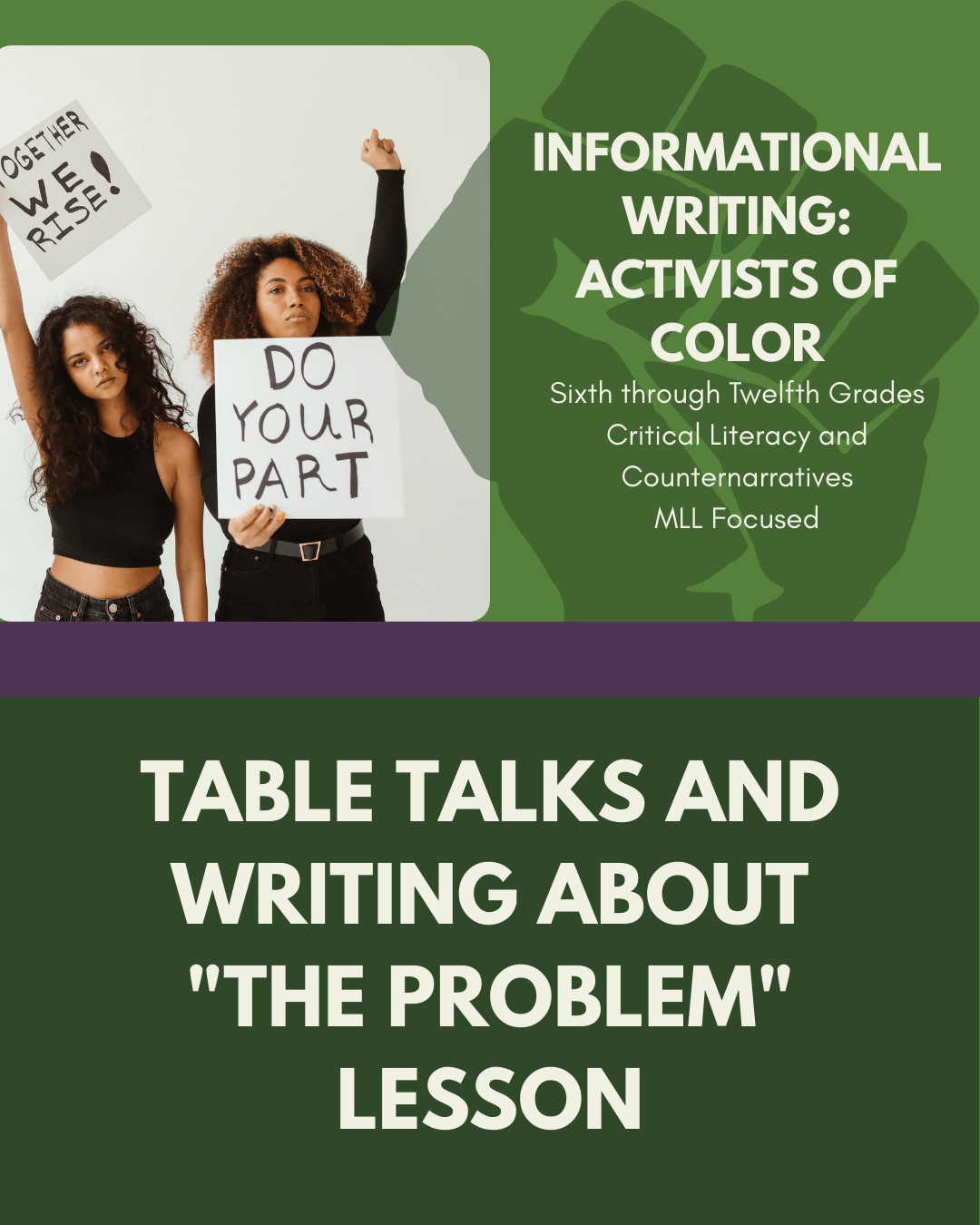
Description
Table Talks and Writing About “The Problem” is where the Informational Reading & Writing Unit gets its teeth. Now that students are experts in their chosen fields—from Immigration Activism to Animal Rights—they must learn to articulate the specific systemic harms they’ve uncovered. This lesson focuses on the Power and Oppression theme of the WAESN framework, pushing students to identify how systems oppress groups in both implicit and explicit ways.
Designed for a 100-minute ELA block, the lesson begins with Table Talks. Using a rubric-backed discussion protocol and specific sentence stems, students practice clarifying and fortifying their ideas with their peers. This oral rehearsal is critical for the second half of the lesson: the writing phase. Using a Scaffolded Paragraph guide, students learn to embed direct quotes, provide context, and offer deep analysis to explain “The Problem” their activists are fighting to solve.
What’s Included
-
Detailed 100-minute lesson plan with a focus on discourse-to-writing transitions.
-
L7. Table Talk Rubric to provide clear expectations for academic conversation and active listening.
-
L7. Informational Paragraph Scaffold: “The Problem”—a step-by-step guide for drafting the first major section of their report.
-
L7. Informational Writing with Rubric for formal assessment and peer-feedback.
-
Sentence Stems for Table Talks designed to help students clarify and fortify their claims.
-
Direct Quote Integration Guide to teach students how to point to evidence effectively.
-
Alignment with WAESN Elements of Liberation (Injustice & Resistance) and CCSS ELA standards for writing and speaking/listening.
Why Educators Use This Lesson
-
Bridges Speaking and Writing: Uses small-group discussion as a pre-writing strategy to build confidence and refine arguments before students put pen to paper.
-
Teaches Technical Rigor: Provides clear, actionable instruction on how to embed evidence and quotes—a high-level skill essential for high school and college readiness.
-
Centers Critical Inquiry: Forces students to look past the surface of an issue to find the systemic problem at its root.
-
Promotes Peer Advocacy: The optional peer-feedback session using sticky notes teaches students how to provide strong evidence critiques to their classmates.
-
High Scaffolding: The paragraph scaffold ensures that every student, regardless of writing level, can produce a sophisticated piece of informational text.
This lesson turns your researchers into critics of the status quo.



Reviews
There are no reviews yet.