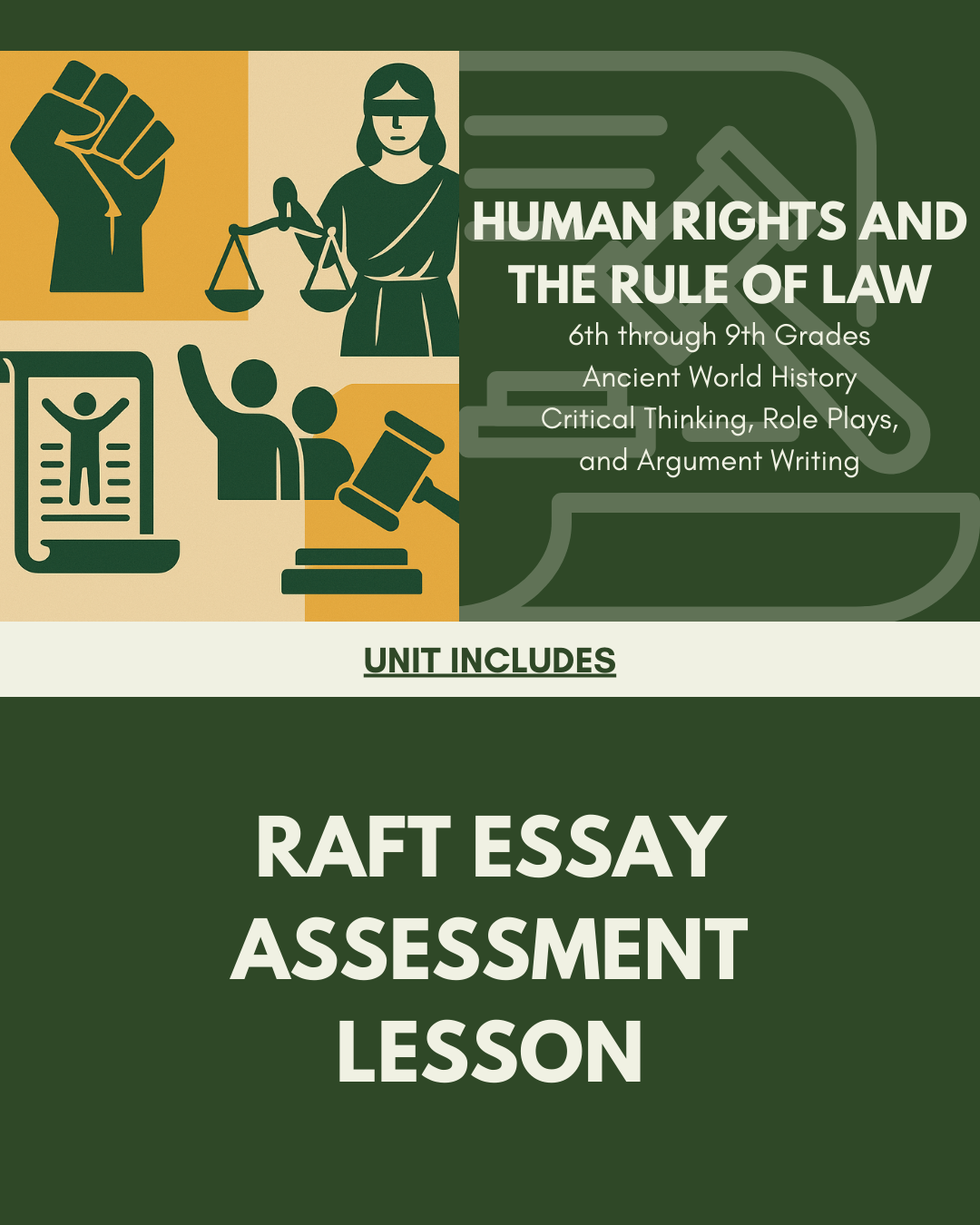
Description
RAFT Essay Assessment is the ultimate expression of student agency and critical praxis. After weeks of investigating ancient codes, international declarations, and modern legal dilemmas, students are given the keys to the courtroom. This summative project moves beyond the standard five-paragraph essay by allowing students to customize their writing experience through the RAFT strategy.
Over the course of three to four class periods, students utilize their accumulated notes—specifically their argument-evidence buckets from Lesson 9—to construct a rigorous written product. Whether they choose to write as a Mesopotamian citizen addressing King Hammurabi or a modern advocate testifying before the UN, they must use academic language and specific evidence to prove their understanding of justice and the rule of law.
The lesson includes a structured check-in process and a comprehensive rubric that emphasizes self-assessment, ensuring students take full ownership of their intellectual work before the final submission.
What’s Included
-
Comprehensive 4-day unit finale with clear pacing for pre-writing, drafting, and self-assessment.
-
L10.1 RAFT Pre-write Graphic Organizer to help students define their role, audience, format, and topic.
-
L10.2 RAFT Assessment Rubric designed for both teacher grading and student self-reflection.
-
Check-in Protocol to provide teacher initials at key milestones, ensuring no student falls behind.
-
Synthesis Instructions for utilizing previous exit tickets and DBQ notes as primary evidence.
-
Alignment with WAESN Elements of Liberation, WA State Social Studies Standards, and CCSS Writing Standards.
Why Educators Use This Lesson
-
Maximum Student Choice: The RAFT format allows students to engage with the content through a lens that resonates with their own identity and interests.
-
Scaffolded Summative Success: The graphic organizer and milestone check-ins turn a complex writing task into a manageable, step-by-step process.
-
Promotes Intellectual Integrity: Requires students to self-assess their work against a rigorous rubric before turning it in.
-
Evidence-Based Mastery: Forces the synthesis of ancient and modern sources, proving that students can track themes of power and oppression across time.
-
Authentic Voice: Moves away from “writing for the teacher” and toward writing for a specific, meaningful audience.
This is the moment where the students become the experts. Give them the platform, and they’ll give you the truth.



Reviews
There are no reviews yet.