
On August 30, 2026, the new superintendent of Seattle Public Schools (SPS), Ben Shuldiner, sent an email to the families of students in the district to purportedly update them on the bargaining process between the district and the teacher association, Seattle Education Association (SEA). However, the meandering 3,300-word-long essay was far more than a report. The updates were padded with scathing critiques of SEA bargaining strategies, misleading statements about bargaining, itself, bizarre appeals to authority, and the near complete abdication of responsibility for the mess that is special education in SPS.
I tend to side eye decisions to bring people in from other states to do this job. Seattle has a very particular political culture. It’s both radical and progressive and entrenched in nepotism and neoliberalism. That’s the tension Superintendent Shuldiner is stepping into coming from Lansing, Michigan. How can he disrupt what needs to be disrupted without being defeated by Seattle politics? The most recent example of that failure is Denise Juneau, who came from a very different political landscape in Montana and was pushed out because she was considered too conservative by Seattleites despite self-identifying as a Democrat.
Differences Between Seattle and Lansing
According to the Lansing State Journal and Politico, Lansing leans left while Seattle is firmly far left. Michigan is a swing state that went to Trump in 2024 while Washington is known for its deep blue roots. On top of that, the demographic differences between Lansing and Seattle are stark.
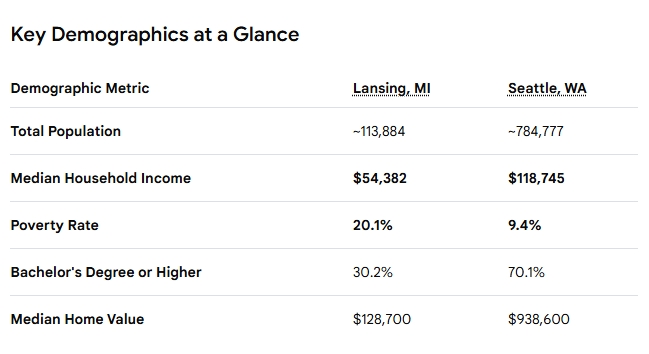
The fact that more than twice as many people in Seattle have a Bachelor’s degree or higher suggests that Seattleites may pay more attention to K–12 politics than Lansingites. The lower poverty rate and gigantic difference in median home values may also explain how so many Seattleites not only have greater interest to be involved in education politics, but also more time than Langsingites.
This clearly presents a need for a cultural adjustment for Superintendent Shuldiner, but he doesn’t seem to demonstrate his understanding of this and not just in the email I mentioned. One of his first quotes that went viral was from a KUOW interview regarding his thoughts on school safety and preference for surveillance. “I want schools to feel like where rich people live, in cathedrals, T-Mobile Park,” Shuldiner said. “When you go through T-Mobile, you’ve got to go through weapons detectors. There’s multiple points of entry, but somebody’s always there, and it’s a way to actually make folks feel safe.” He clearly hasn’t read up on the heated debates in Seattle that lean away from surveillance and policing in schools. The quote also comes off as elitist. School doesn’t need to feel like where rich people live or a cathedral. It needs to be safe and welcoming. I’ve felt neither safe nor welcome in the homes of rich people or cathedrals.
The Email
What was supposed to be an update on bargaining meant to assure families that all would be well, quickly escalated into an exercise in finger-pointing. He starts off well enough by explaining why districts don’t often share their perspective of the bargaining process, but 119 words into this 3,300 word email, he takes his first shot at SEA by passive aggressively critiquing their use of a poop emoji in their public communications about the process.This is what many Seattleites would consider tone policing. It also ignores the reality that the core of the SEA body is made of millennials. SEA is using culturally responsive communication to engage its members—something all educators should be doing.
He goes on to place all blame for stalled negotiations on SEA and stating, “There is absolutely no reason to strike other than to flex a power play.” That struck me as odd the first time I read it, because, yes. That’s exactly what a strike is: an exercise of collective power. That’s the entire point. The fact that he’s stating a fact as a problem is clearly a power play. But it gets more odd.
He opens his Next Steps section (an email that has headers is an essay, not an email) near the end of the email with an entire paragraph touting his labor union credentials. It was clearly an appeal to authority, because the statement about a strike being nothing more than a power play is not one any seasoned labor leader would make. In my experience, Seattleites tend to hate appeals to authority, even when the authority makes sense. We also hate people who use lived experience to justify bad politics and people who don’t take accountability.

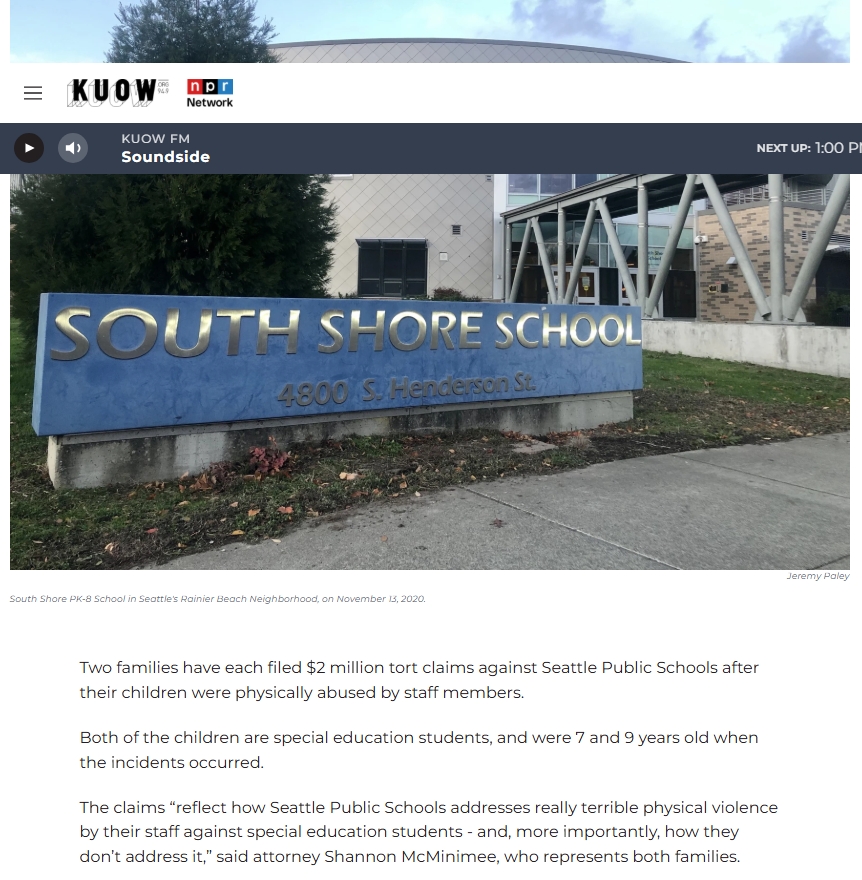
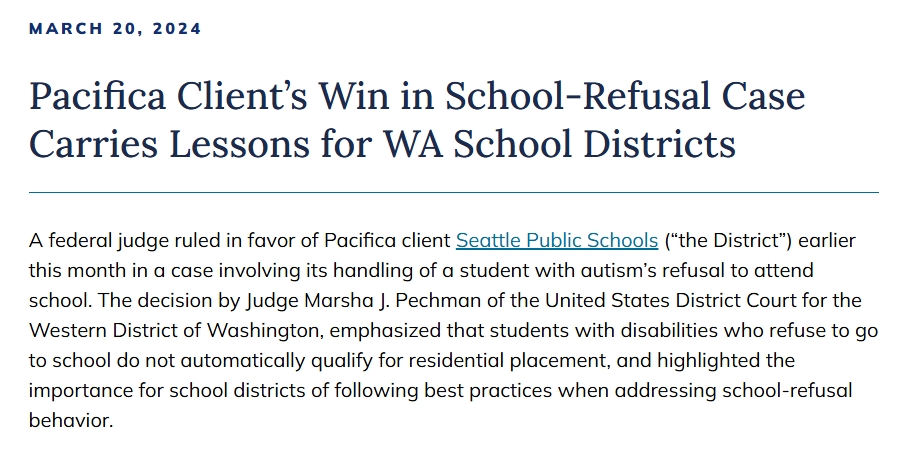
The latter point was the sticking point for most Seattleites, especially because of Superintendent Shuldiner’s apparent implication that the district has no agency over how special education needs are met when he said, “… since SEA took special education off the bargaining table, the district … can’t try to address the very real needs of the students.” Special education is probably the most heated and debated topic in Seattle. When a sitting superintendent basically throws up their hands and says, “Well, if the teachers won’t do anything about it, I guess we can’t do anything,” you can be sure people will respond. Yes, he followed that by proposals the district made in the bargaining process, but I would argue that many of the failures in special education are caused by district policies, administration, and implementation, not a collective bargaining agreement. Based on the number of lawsuits against the district directly related to special education services for students not being met (mine included), I think many families would agree.
The Tension
The nepotism and mismanagement in SPS is well-documented and likely requires an outsider to disrupt. The most egregious example is what happened with James Johnson, a teacher at Meany Middle School who was seen punching a student on a school security camera. Then principal, Chanda Oatis, was found to have actively covered up Johnson’s history of abuse, including accusations of sexually grooming female students at Nova High School, and lobbied for his retention with then superintendent Larry Nyland. The district initially proposed firing Johnson, but Katrina Hunt, principal of Washington Middle School and biological and Alpha Kappa Alpha (AKA)/Delta Upsilon Omega (DUO) sister of Oatis, told SPS HR that she would love to have Johnson at Washington. After the public exposure of Johnson’s actions and history, he was moved once more to The Center School, all under the leadership of Sarah Pritchett, the Executive Director of Schools for the region in question and an AKA/DUO sister of Oatis and Hunt.
Under Brent Jones’ tenure, Dr. Pritchett was promoted to Assistant Superintendent of Human Resources (HR). This points to the issue of mismanagement. It is common practice to promote former principals to cabinet-level positions who have no training, experience, or expertise for that position. Yes, a principal manages school staff, but management skills and responsibilities are not the same as HR skills and responsibilities. The latter requires far more knowledge and training on labor laws.
One of Shuldiner’s first acts as superintendent was placing Dr. Pritchett on administrative leave in August of this year. She is being investigated for her role in the Johnson case and failure to reform misconduct responses. Shuldiner subsequently initiated an audit of HR practices. This is exactly how an outsider can disrupt entrenched systems of mismanagement and nepotism. A local might be more likely to support the status quo; however, his email about the bargaining process falls into a different status quo trap.



It’s important to note here that Hunt, who welcomed Johnson to Washington Middle School, was promoted to Executive Director of Middle Schools in July of this year, and Oatis is still serving as principal of Meany Middle School.
Back to the Email
In my first meeting with Superintendent Shuldiner, we talked about the toxic culture of the district, including the harmful, “us vs them,” dynamic between district staff and SEA. He told me that was an issue he intended to correct. I think the email escalated that dynamic to heights I haven’t seen since the 2015 strike.

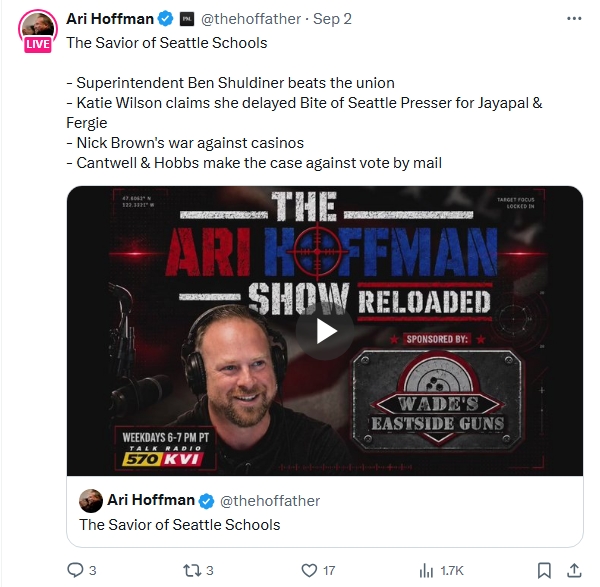
The position taken and statements made in Shuldiner’s emails are being used to support the anti-education, anti-teacher, and anti-union screeds of right-wing talking heads and organizations. Ari Hoffman, conservative shock-jock known for attacking and doxxing public-school teachers, proclaimed Superintendent Shuldiner as the “savior of Seattle schools” and praised him for, “beating the union.” I know very well that a leader can’t please all the people all of the time, but when you’re pleasing the likes of Ari Hoffman, you might want to do some reflection work. Members of SEA are watching this closely, and many have taken to their own social media accounts to call out Shuldiner’s divisive actions. Shuldiner’s subsequent newsletter included several apologies, but when addressing the criticism that his earlier email attacked SEA, he reverted to the familiar conditional construction: “I am sorry if anyone took my words as an attack.” Emphasis is my own.
Values-Aligned Hope
Ethnic Studies as a practice should be hyper-local, so it makes sense that leaders should be local. However, with how bad SPS has become and how large it is, an outsider may be the right choice right now. I still have hope that Superintendent Shuldiner will at least begin to turn things around, but only if he has the political literacy to read the room. I know he’s met with a lot of people and is willing to meet with anyone regardless of their politics. That’s good only if the explicit and implicit data being collected in those meetings is skillfully used to understand the terrain better. I haven’t seen that, yet.
Yes, things are a mess. Yes, things need to be disrupted. However, the majority of the citizenry of the district have repeatedly let it be known they want things to stay left of center. I’ve only heard loud support for teachers from a large majority of SPS families. Much of the anti-teacher and anti-union rhetoric comes from people outside of the district. The biggest complaints coming from SPS families are about district policies, leadership, and actions. I hope Superintendent Shuldiner listens more critically.
If you agree, feel free to forward this blog post to him at boshuldiner@seattleschools.org with your own comments. You can also contact the school board to let them know you want them to hold him accountable to change that aligns with the explicitly stated values of the district, including antiracist practices and meaningful community engagement.

Leave a Reply