Description
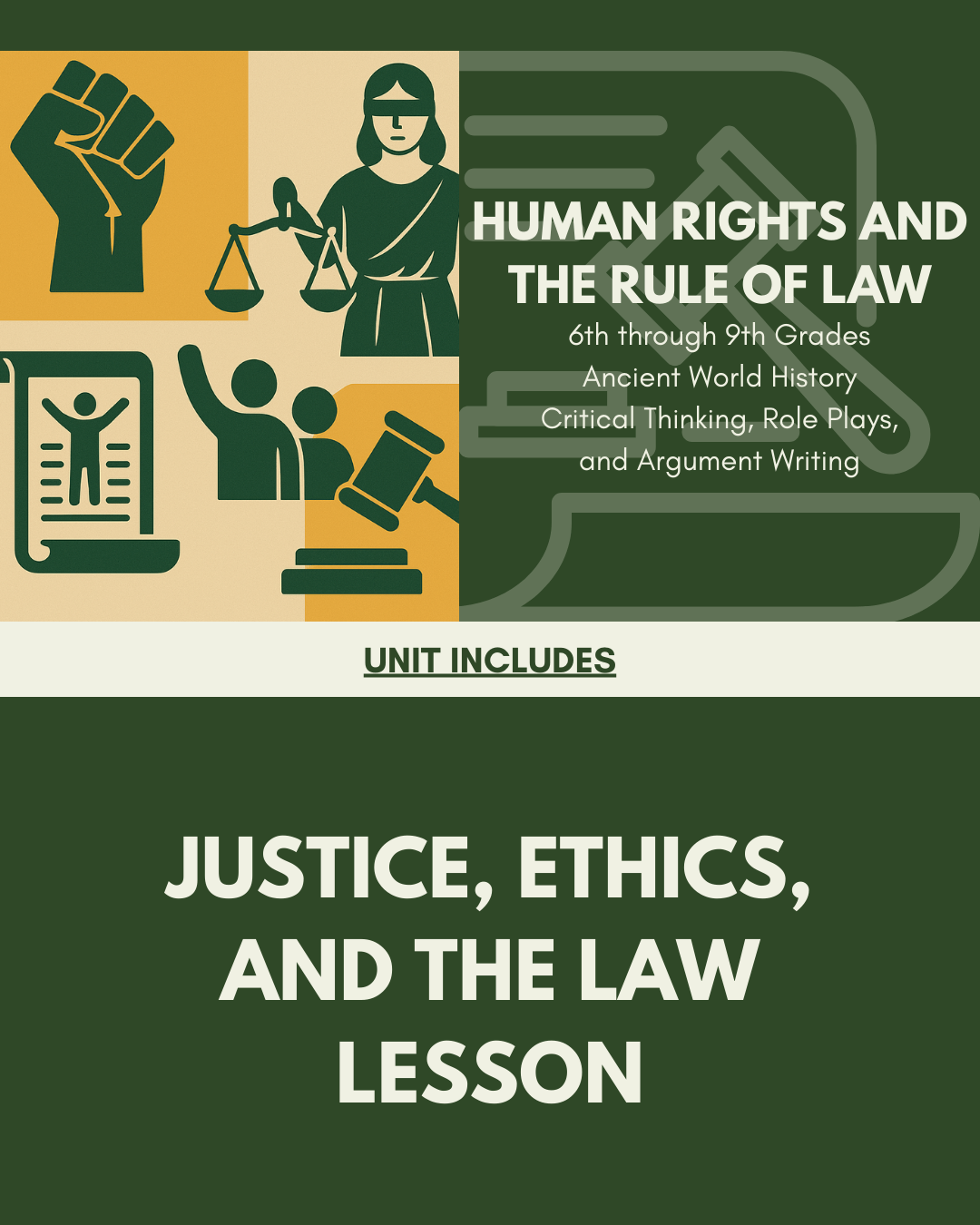
Justice, Ethics, and the Law moves from theoretical rights to the messy, real-world application of the rule of law. As a vital component of the Human Rights and the Rule of Law unit, this lesson places students into the role of decision-makers, inviting them to grapple with the unintended consequences of legislation on marginalized and oppressed communities.
Educators can choose between two paths or teach both as a two-part sequence. In The Queen vs Dudley and Stephens track, students perform a skit based on a 19th-century survival case at sea, debating the morality of “necessity” versus the letter of the law. In the Vague Law track, students analyze modern-day “Don’t Say Gay” legislation before rotating through stations as City Council members. Their mission: “hear” community complaints and rewrite a flawed law to make it truly fair and equitable.
The lesson centers the WAESN framework of Power and Oppression, asking students to identify who is still left out even after a law is edited for fairness.
What’s Included
-
Flexible 1–2 period lesson plan with instructional paths for two distinct activities.
-
The Queen vs Dudley and Stephens Skit Materials including character roles and case background.
-
Vague Law Station Materials featuring resident complaints (L5.5) and laws for analysis.
-
Media Guide for analyzing current events, including Florida’s “Don’t Say Gay” bill.
-
City Council Note-Taking Prompts to scaffold the law-editing process.
-
Reflection Exit Tickets focused on identifying persistent systemic exclusion.
-
Alignment with WAESN Elements of Liberation and WA State Social Studies Standards for Civics.
Why Educators Use This Lesson
-
Authentic Roleplay: Whether as sailors at sea or city officials, students must “act on” their beliefs, moving from passive learning to active praxis.
-
Critical Media Literacy: Uses contemporary news reports to show that vague laws aren’t ancient history—they are happening right now.
-
Collaborative Problem Solving: Station activities require groups of 3–5 to negotiate, compromise, and rewrite policy in real-time.
-
Focus on Unintended Consequences: Explicitly teaches students to look for how laws can unintentionally harm oppressed groups.
-
High Engagement: The macabre nature of the maritime case and the relevant modern examples keep middle schoolers deeply invested in the outcome.
This is the lesson that turns your classroom into a courtroom and your students into the next generation of legal reformers.




Reviews
There are no reviews yet.