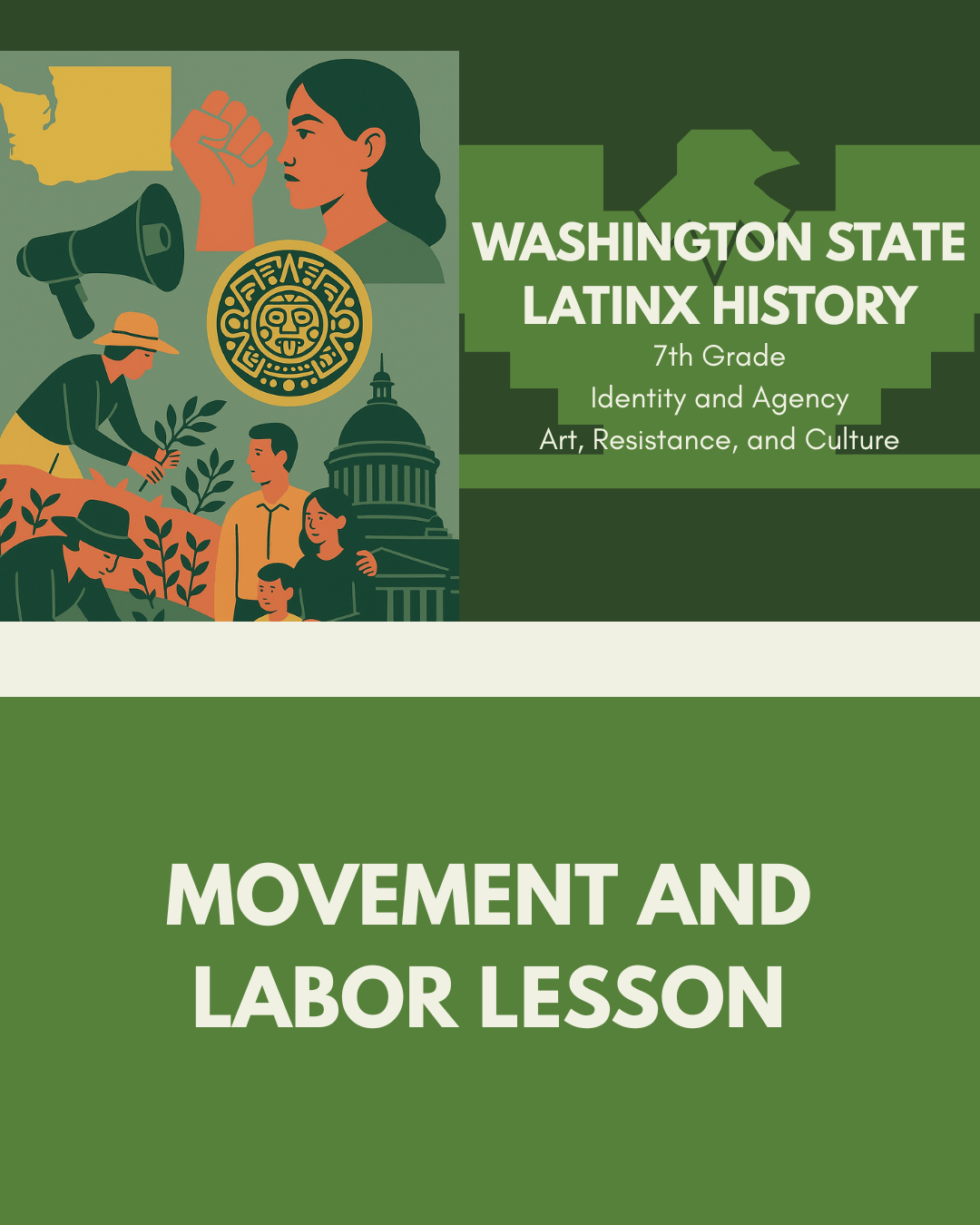
Description
Movement and Labor transforms students into historians by teaching them to interrogate the silences in traditional archives. This lesson centers on the Resistance and Liberation and Power and Oppression frameworks by contrasting official government documents with personal testimonios. It centers the life of Antonia Castañeda, who migrated from Texas to Washington as a child, providing a first-hand account of the labor and cultural shifts that defined the Latinx experience in the Pacific Northwest.
Designed for a 90-minute block, the lesson begins by defining “A People’s History”—a perspective that prioritizes the common person over institutional power. Students engage in a hands-on Analyzing Sources Workshop, where they evaluate five different types of evidence: photographs, letters, government reports, their own personal archives, and oral histories. The lesson culminates in a deep-dive annotation of Castañeda’s oral history, where students reflect on how home culture and “Tejana” identity serve as tools of survival and resistance.
What’s Included
-
Detailed 90-minute lesson plan including step-by-step guidance for facilitating discourse on “history from below”.
-
Analyzing Sources Graphic Organizer to scaffold the identification of power and perspective in historical documents.
-
Antonia Castañeda Oral History Activity Guide with 12 analysis questions and annotation codes.
-
Antonia Castañeda Oral History Excerpt specifically curated for secondary reading levels.
-
Reflective Journaling Module focused on the concept of being “raised Tejana” and maintaining cultural roots.
-
Formative Assessment Routine that connects student life (social media, diaries) to the concept of the historical archive.
-
Alignment with WAESN Elements of Liberation (Resistance & Liberation, Power & Oppression) and WA State Social Studies standards for historical inquiry.
Why Educators Use This Lesson
-
Teaches Critical Inquiry: Moves students beyond memorizing dates to analyzing the power differentials behind who gets to write history.
-
Personalizes History: By identifying their own personal archives (social media, sports schedules), students realize that their own lives are part of a future historical record.
-
Centers Chicana Excellence: Highlights the work of a professional historian of Color, providing a powerful academic mirror for students.
-
Scaffolded Literacy: Uses clear graphic organizers and annotation options (highlighters, stickies, tabs) to make dense archival texts accessible to all learners.
-
Integrates Oral Tradition: Validates interviews and testimonies as rigorous, primary sources that are essential for a complete “people’s history”.
This is the lesson that teaches students that history isn’t just about what happened—it’s about who was allowed to tell the story.



Reviews
There are no reviews yet.