
Description
Human Rights Vocabulary sets the stage for critical inquiry by giving students the linguistic tools to dismantle Eurocentric narratives. As the opening act of the Human Rights and the Rule of Law unit, this lesson ensures that every student, regardless of their starting point, has a firm grasp on the high-level vocabulary required to engage with history through an Ethnic Studies lens.
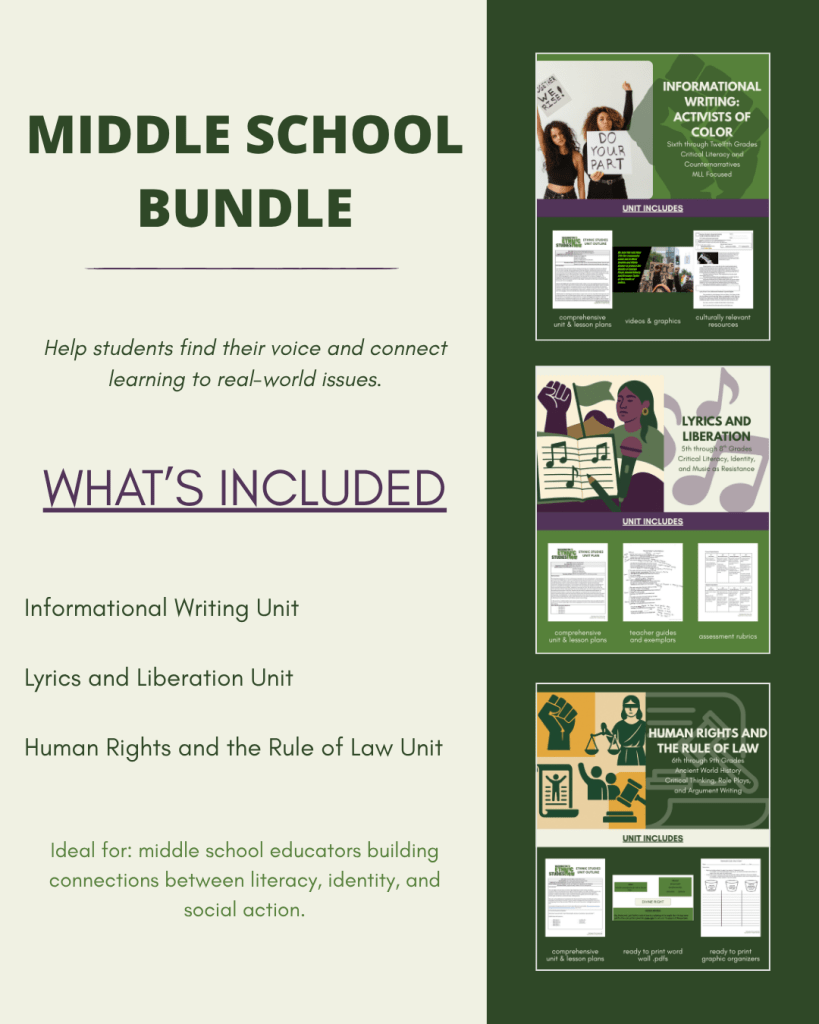
Designed for 6th or 9th grade classrooms, this lesson moves away from stale dictionary drills and into the realm of experiential learning. Students build vocabulary into the literal fabric of the classroom with an interactive word-wall.
The highlight of the lesson is a silent consensus challenge. Students must use hand gestures and non-verbal cues to reach a unanimous class consensus on how to represent complex concepts like inalienable rights and codify. It’s a masterclass in collective action and communication that bridges the gap between ancient law and modern social justice.
What’s Included
-
Complete 1-period lesson plan with step-by-step facilitator guidance.
-
L1.1 Vocabulary Glossary Handout featuring accessible definitions for academic and Ethnic Studies terms.
-
Word Wall PDFs for classroom environment transformation.
-
Interactive Game Strategy using Quizlet (or similar) to reinforce retention through friendly competition.
-
L1.2 Vocabulary Homework Packet (can be adapted for in-class collaborative work).
-
Alignment with WAESN Elements of Liberation and CCSS Literacy standards for 6th–9th grade.
Why Educators Use This Lesson
-
Establishes a Shared Language: Ensures all students can participate in rigorous discussions about power, identity, and resistance.
-
Kinesthetic & Accessible: The silent consensus activity is perfect for ELL students and kinesthetic learners, lowering the barrier to entry for complex vocabulary.
-
Centers Praxis: Moves beyond rote memorization to Action and Reflection by having students negotiate meaning as a community.
-
Versatile Implementation: Works as a high-energy whole-group session with options for independent or small-group reinforcement.
Don’t let your students go into a unit on human rights without their “legal counsel”—give them the vocabulary they need to win the argument.



Reviews
There are no reviews yet.