by Dr. Tracy Castro-Gill
So, I’m officially unemployed, which means I have more time to write, which I actually enjoy when I’m not compelled to do it, or when it’s not part of grantwriting. I’ve been kicking around the idea of writing a book for a long time, but none of the topics I’ve pondered ever appealed to me enough to do more than write a sample chapter. The chapter I wrote was on making sure we use the correct language when we talk about antiracist and Ethnic Studies education policy. I may include that in this series. It may even end up in this first installment. Who knows?
One topic, however, that keeps coming up in interesting and varied ways is that of classroom management and what it looks like in a student-centered classroom. If you know me or have completed any professional development with me, one of my most used refrains is, “You can’t lecture and quiz your way through Ethnic Studies.” I get so depressed when I peer into a classroom and see straight rows of desks in tidy lines. How sad it must be to be stuck in those classrooms for hours on end, days on end, with no chance to be human with the other humans in the room. I remember what that was like, and I HATED it, which is why the rooms I taught in never looked like that. My classrooms have always been student-centered, loud, and bustling places full of joy (most of the time). But I’m learning that when teachers hear, “student-centered,” some of them jump to student free-for-all, because they’ve been taught— often in teacher preparation programs and from their administrators—that classroom management means the teacher must have total control of all student behaviors at all times. This series aims to clarify a few things.
TRUST
My fondest memories of school, and my teachers, involved classrooms that were alive, loud, and full of motion and commotion. The teacher that inspired me to teach was named Ms. Cassford. She was my 8th grade social studies teacher at Lakeside Junior High School in Norwalk, CA. Oh, I loved her. I loved her because she challenged and pushed me to be better and understand more. I credit her with instilling in me a love for learning. I always loved it, but Ms. Cassford brought it to a new level. Her secret? Trusting me and every other student she taught.
I don’t mean trust as in, she trusted us not to misbehave or not to steal things, etc. She trusted us to understand complex topics and take them seriously in our learning experiences. While Ms. Cassford inspired me to teach, one of her units inspired me to eventually become an Ethnic Studies educator: The Holocaust. I was 14 years old when we started that unit. I remember it like it was yesterday instead of 36 years ago. In 1989, I learnt about The Holocaust mostly through primary sources, including the Russian videos of liberating prisoners from Nazi death camps. The images were so gruesome and disturbing that Ms. Cassford had to have signed permission slips for us to engage in the lessons.
In a classroom that was usually raucous, and a lot of time full of silliness and laughter, my peers and I were transfixed. Part of it was the gravity of the learning material, but most of it was the way it was presented by Ms. Cassford. It wasn’t what I call “trauma porn,” because Ms. Cassford didn’t stop with the horrific images. She pushed us to understand the human conditions that led to these crimes against humanity, and she included stories and examples of Jewish resistance.
This is the trust I’m talking about—she trusted a group of goofy and awkward 14-year-olds to hold this inhumane period of history in our hearts and minds and do something with it. She trusted that we could take what she presented and make meaning from it, not simply passively consume it and feel sorry for whomever lived and died during those years. And we did.
One of the many things I took away from that learning experience was that the most essential component of classroom management is trust between a teacher and their students. We know from research that a positive relationship between teachers and students is one of the top factors in positive student outcomes, and what I’ve found missing from the research is a description of what that means. What is involved in positive teacher/student relationships that result in positive outcomes? My first answer in this series is trust.
So, let’s first define and understand trust in this context. I believe that words hold different meanings in different contexts. Contrary to popular belief, not everyone defines things the same way. Cultural and linguistic differences add nuance to words that dictionaries leave out. I do, however, always like to start with dictionary definitions so that we can trouble them and find the nuance in doing so. The following definitions were found in the online Oxford English dictionary for trust:
- noun: the firm belief in the reliability, truth, ability, or strength of someone or something
- verb: to believe in the reliability, truth, ability, or strength of
It’s important, when criticizing these definitions, to point out that all of the indicators of trust are subjective: reliability, truth, ability, strength. For example, a teacher with a conventional understanding of ability may define this as a student’s ability to be still and quiet at all times, so that teacher’s definition of trusting their students isn’t the same as mine. If I were to take these definitions and rewrite them using Ms. Cassford’s example of trust specific to student-centered classroom management, they might look something like this:
- noun: the firm belief in the capacity of students, regardless of age, ability, or identity, to achieve expected outcomes
- verb: to believe in the agency of students, both individually and as a group, regardless of age, ability, or identity
I do appreciate the emphasis on the words belief and believe. A well-respected education advocate in Seattle, SebRena Burr, uses the term, “belief gap,” in place of opportunity gap, indicating that gaps exist because adults in the education system lack this version of trust in their students. I’ve also replaced ability with capacity in the noun definition to provide a counternarrative to ableism in the Oxford dictionary’s definition. A disabled person may not be able to personally address their basic needs, but that doesn’t mean they lack the capacity to have them met. This is where assistive devices, medications, service animals, caretakers, prosthetics, etc come in. My youngest child has dyscalculia and dyslexia. They can’t keep numbers and letters in their head to save their life! But with a calculator, they can solve complex mathematical equations just as easily as their neurotypical peers, therefore having the same problem-solving capacity. A student who has been labeled unruly by their teachers has the same capacity as their peers to meet expected outcomes given a different environment, learning opportunities, adult interactions, etc. In order to trust our students and create student-centered classrooms, we have to dismantle the ableist idea of ability.

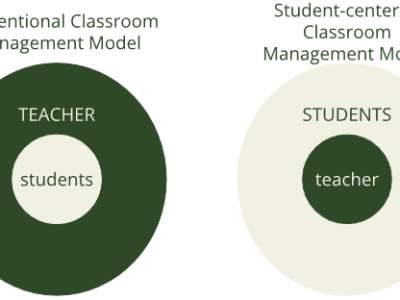
Student-centered classrooms are not free-for-alls. They are classrooms where students have been entrusted to act on their agency of self and classroom management and their capacity to hold themselves and each other accountable to their learning and learning outcomes. Many Ethnic Studies scholars describe this as relational accountability. More on that in upcoming installments. The teachers who go straight to visions of students doing (or not doing) whatever they want in a student-centered classroom are responding to the fear of letting go of the control they’ve been taught to wield; their belief that, without being told what to do, children will run amuck. If left to their own devices without any guidance, this might be true, but remember: student-centered means the teacher is marginalized, not absent. The teacher becomes the coach or mentor. They are still needed to support the students in the process of managing their classroom, and students frequently need to be taught how to use their agency as it may be the first time an educator trusted them to do so.
I’m not sure what the next installment of this series will be, or if it will even be. At this point in time I’m thinking it might be on challenging token economies like positive behavioral intervention systems (PBIS), but I’d like to leave you with some reflection questions to chew on between now and then:
- If the idea of a student-centered classroom causes any type of anxiety response, where is that response coming from?
- If you are the type of teacher who feels like they need to be in control of all or most decision making in a classroom, how is that working? Are students compliant, or do you have a lot of issues with student engagement?
- If you believe you are a student-centered teacher, but your classroom feels out of control, have you taken time to explicitly teach and coach your students through self-management, or did you just expect them to come to you equipped with those skills?
Leave a Reply