


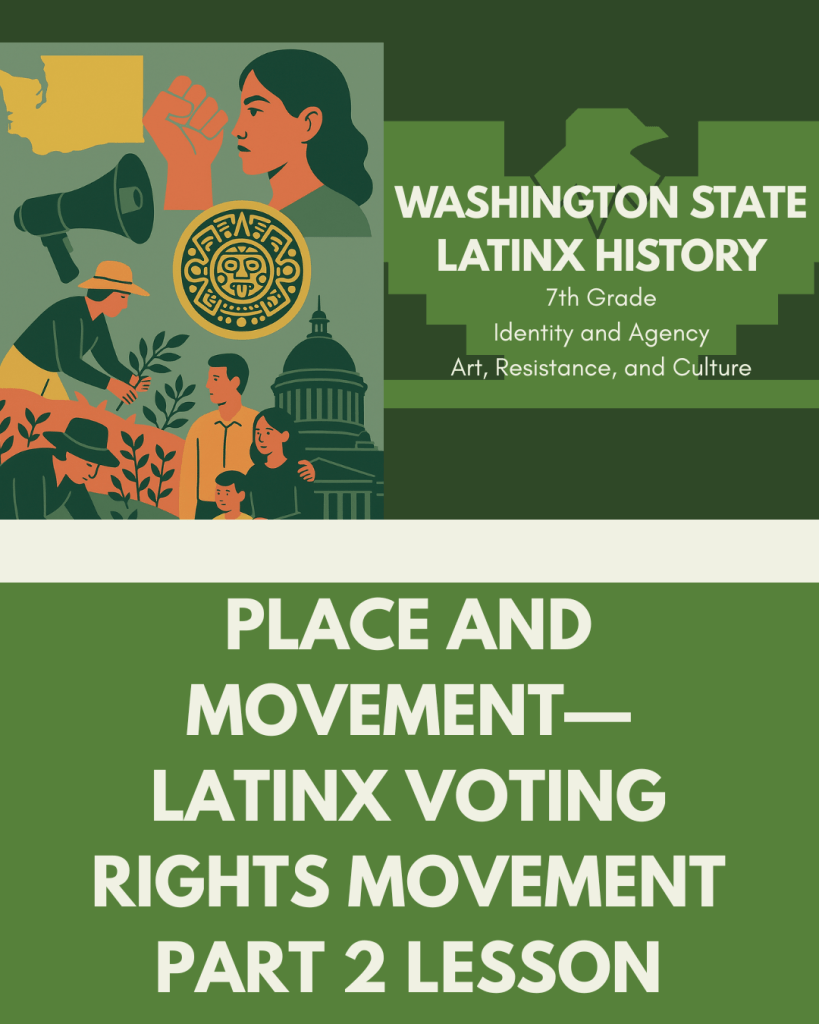
Latinx Voting Rights Movement Part 2 provides a profound look at how marginalized communities exercise agency in the face of legal defeat. This lesson centers on the Resistance and Liberation and Action and Reflection frameworks by documenting the specific ways Chicanx leaders in Yakima County mobilized to challenge the state’s English literacy tests.
Designed for a 90-minute block, the lesson begins with an Experiential Learning scenario based on the real life of Cesar Jimenez, a U.S. citizen whose lack of English literacy disqualified him from the 1964 presidential election despite his deep civic engagement. Students take a physical stand in the room to debate the fairness of such laws before diving into primary sources, including newspaper articles from the Tri-Cities Herald and Seattle Times. The core of the lesson is a deep-dive into the lawsuit filed by the Mexican-American Federation with the support of the ACLU and activist Guadalupe Gamboa. Students analyze the 1969 court ruling—which initially favored the state—and reflect on how this struggle eventually led to the national 1970 expansion of the Voting Rights Act that finally outlawed literacy tests for good.
What’s Included
-
Detailed 90-minute lesson plan with structured discourse support for high-stakes civic conversations.
-
Cesar Jimenez Experiential Scenario to build historical empathy and critical thinking regarding legal fairness.
-
Primary Source Media Module featuring 1960s-era newspaper clippings documenting the challenge to Yakima County voting laws.
-
Guadalupe Gamboa Interview Guide to analyze the arbitrary nature of literacy tests through the eyes of a local activist.
-
Voting Rights Act Map Analysis to hypothesize why Washington state was initially excluded from federal literacy test suspensions.
-
WAESN Framework Alignment (Resistance & Liberation, Action & Reflection) and C3 Framework for Social Studies Standards.
Why Educators Use This Lesson
-
Centers Local Activism: Highlights the work of home-grown Washington activists like Guadalupe Gamboa, a graduate of Sunnyside High School and the UW.
-
Teaches Intersectionality: Explicitly connects the Latinx struggle for the ballot to the Black Americans’ struggle that inspired it.
-
Builds Legal Literacy: Students analyze actual court rulings to see how “neutral” questions (like “Can you read English?”) can be weaponized as discriminatory tests.
-
Encourages Active Reflection: The “stand on a side” activity requires students to put their personal values into dialogue with historical law.
-
Demonstrates Persistence: Shows that even when a lawsuit is lost in court, the collective pressure can lead to monumental national change.
This lesson proves that while the law may be written by those in power, it is the people’s movement that eventually corrects it.