


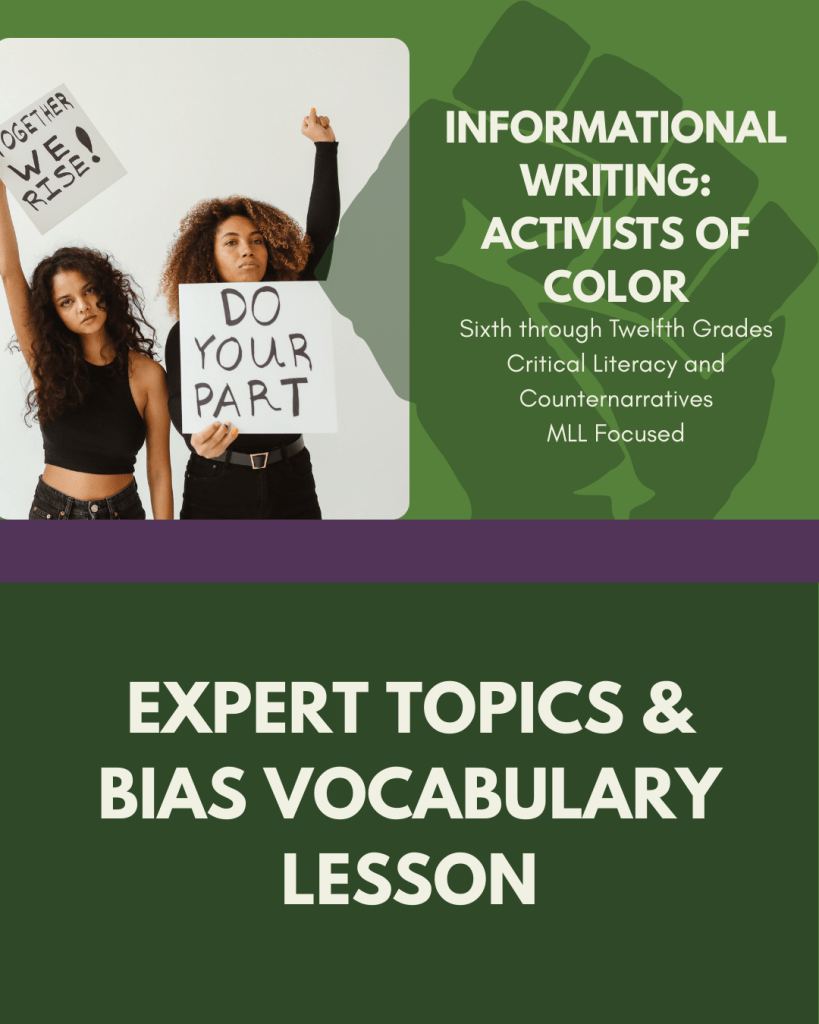
Expert Topics & Bias Vocabulary is the “choose your own adventure” moment of the Informational Reading & Writing Unit. This lesson shifts the cognitive load onto the students by allowing them to form “Expert Groups” based on their personal interests and identities. By providing a curated menu of contemporary issues, this lesson ensures that every student is writing about something they find worth fighting for.
The lesson is a masterclass in vocabulary acquisition. Through a series of interactive games and movement-based activities (stand for implicit, sit for explicit), students deconstruct how bias functions in society. They then apply this lens to a preliminary research phase, watching introductory media for their chosen expert topic—ranging from Greta Thunberg’s climate activism to the racist history of U.S. immigration policy.
The session wraps up with a choice-based writing prompt, where students use their new vocabulary to describe how activists challenge both hidden (implicit) and obvious (explicit) systems of power.
What’s Included
-
Detailed 100-minute lesson plan with expert group sorting protocols.
-
Curated Multimedia Menu featuring 9 distinct activism pathways (Climate, BLM, LGBTQ+, Indigenous Rights, etc.).
-
Implicit vs. Explicit Bias Game Guide with visual aids for classroom use.
-
L5. Informational Writing with Rubric to scaffold short-form academic responses.
-
Expert Group Selection Tool using a top three choices sticky-note protocol.
-
Alignment with WAESN Elements of Liberation and CCSS ELA standards for vocabulary and informational writing.
Why Educators Use This Lesson
-
Maximum Student Agency: Allowing students to choose their Expert Topic drastically increases writing stamina and engagement.
-
Dynamic Vocabulary Instruction: Moves past rote memorization into active, physical engagement with complex sociological terms.
-
Differentiated Media: Provides a wide range of video resources at varying levels of complexity to support all learners.
-
Collaborative Foundations: Establishes the Expert Groups that will sustain student research and peer-support throughout the remainder of the unit.
-
Deep Critical Thinking: Forces students to look for the implici” layers of social issues, moving their writing beyond the surface level.
This is the lesson that turns your classroom into a coalition of experts.