


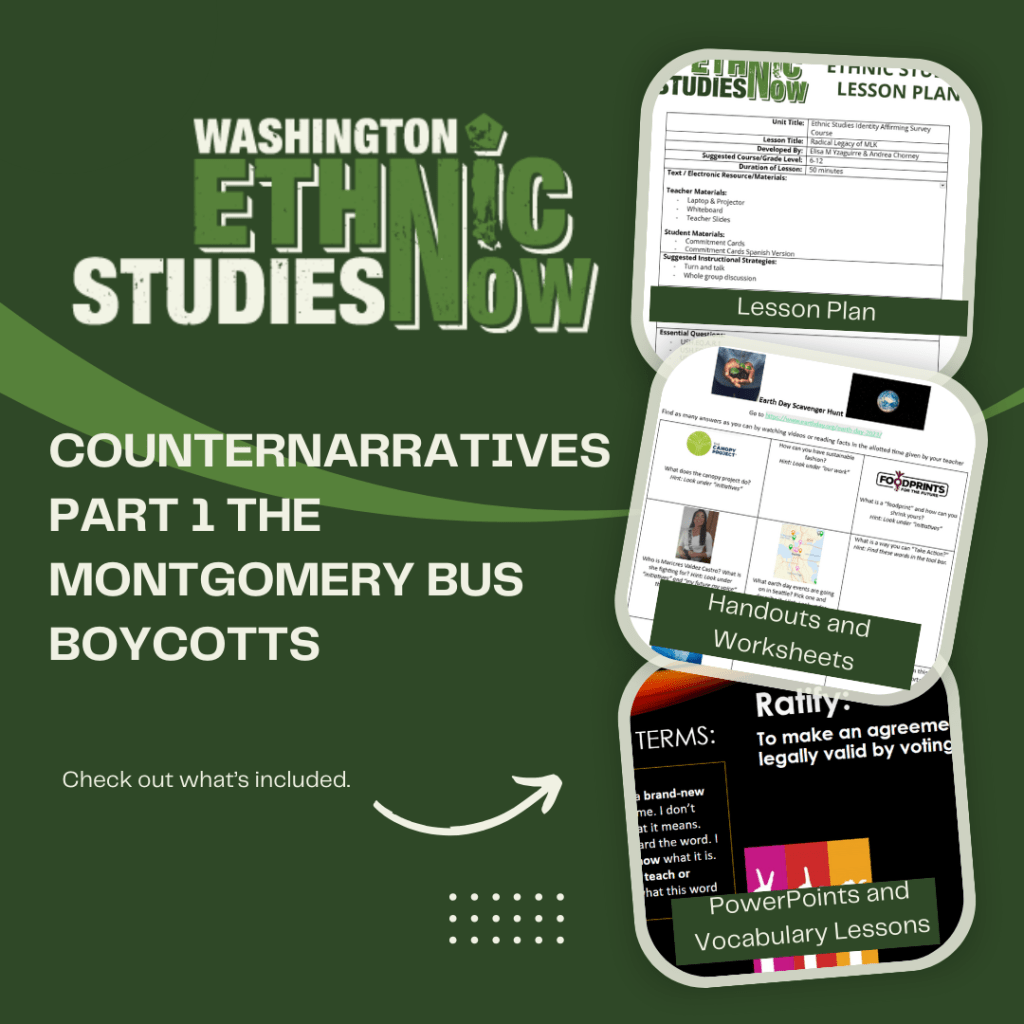
Ethnic Studies Counternarratives Part 1: Montgomery Bus Boycotts challenges simplified, hero-centered versions of the Civil Rights Movement by centering the collective leadership and organizing labor that sustained the Montgomery Bus Boycott. Grounded in Ethnic Studies and counter-narrative pedagogy, this lesson helps students understand social movements as collaborative efforts shaped by many voices, identities, and strategies.
Designed for grades 6–12, this 50-minute lesson supports students in building foundational vocabulary—including boycott, segregation, and counter-narrative—before engaging with text and video that highlight often-overlooked leaders, particularly Black women organizers in Montgomery (pages 1–3).
Students complete a structured worksheet that includes vocabulary work, a KWL reflection, and written responses to media prompts. Through guided discussion and reflection, students examine how dominant historical narratives are constructed, whose stories are centered or erased, and why Ethnic Studies prioritizes counter-narratives as a tool for justice-oriented learning.
The lesson concludes with an optimistic closure activity that reinforces student understanding of resistance, liberation, and civic engagement—without relying on a heroes-and-holidays approach.
Educators are supported with slide-based directions, minimal preparation requirements, and flexible discussion options to meet a range of classroom contexts.
What’s Included
-
Complete 50-minute lesson plan with clear pacing
-
Slide-based instruction with embedded educator guidance
-
Student worksheet with vocabulary, KWL, and reflection sections
-
Media-based learning highlighting counter-narratives
-
Discussion and formative assessment prompts
-
Alignment with WAESN Elements of Liberation, Washington State Social Studies Standards, and C3 Framework
Why Educators Use This Lesson
-
Centers collective leadership over single-hero narratives
-
Highlights the organizing labor of Black women
-
Builds critical historical thinking and vocabulary
-
Supports respectful discussion of race, resistance, and power
-
Minimal prep with strong instructional scaffolds
This lesson is ideal for educators seeking secondary Ethnic Studies curriculum that introduces counter-narratives, strengthens historical analysis, and helps students understand movements as collective, intersectional efforts.