


Cultural Appropriation provides secondary students with the language, frameworks, and critical thinking skills needed to understand one of the most frequently misunderstood concepts in contemporary discussions of culture and identity. Grounded in Ethnic Studies, this lesson supports students in examining how power, history, and inequality shape cultural exchange.
Designed for grades 6–12, this 50-minute lesson uses structured turn-and-talks, whole-group discussion, and media analysis to help students define cultural appropriation and clearly differentiate it from cultural appreciation. Students engage with real-world examples, guided questions, and reflective prompts to explore how cultural practices, symbols, and identities can be misused, erased, or commodified—particularly when power imbalances are ignored.
The lesson is intentionally discussion-centered and requires minimal materials, making it accessible while still addressing complex topics with care. Educators are supported with slide-based guidance that helps facilitate respectful dialogue without placing the burden of explanation on students from marginalized communities.
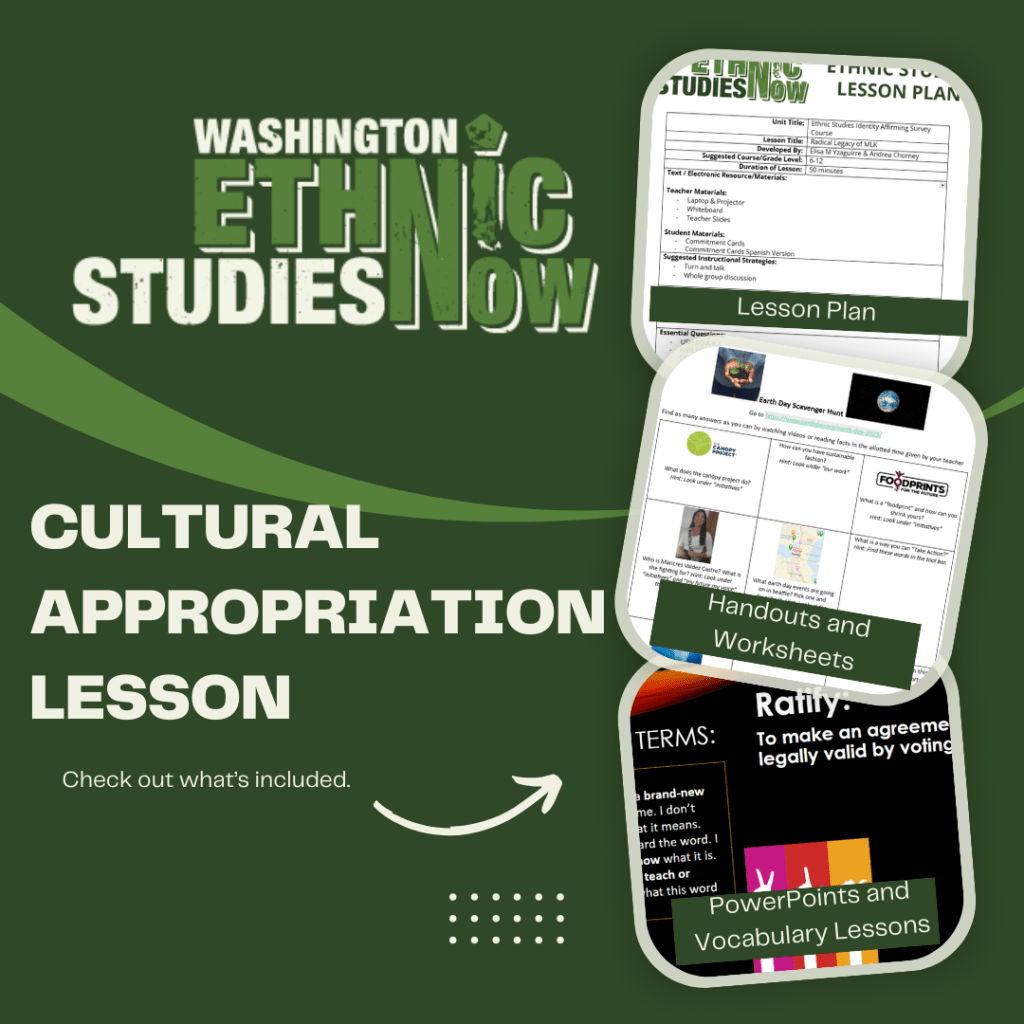
What’s Included
-
Slide-based lesson with embedded educator guidance
-
Structured turn-and-talk and whole-group discussion prompts
-
Media-based learning to challenge misconceptions
-
Vocabulary development focused on power, erasure, and respect
-
Optional written reflection prompts
-
Alignment with WAESN Elements of Liberation, Washington State Social Studies Standards, and C3 Framework
Why Educators Use This Lesson
-
Clarifies a commonly misunderstood concept
-
Helps students analyze culture through a power-aware lens
-
Encourages respectful, critical discussion
-
Requires minimal preparation while supporting complex learning
-
Builds skills for navigating identity and cultural exchange thoughtfully
This lesson is ideal for educators seeking secondary Ethnic Studies curriculum that addresses cultural appropriation with nuance, clarity, and a strong grounding in justice-oriented analysis.