


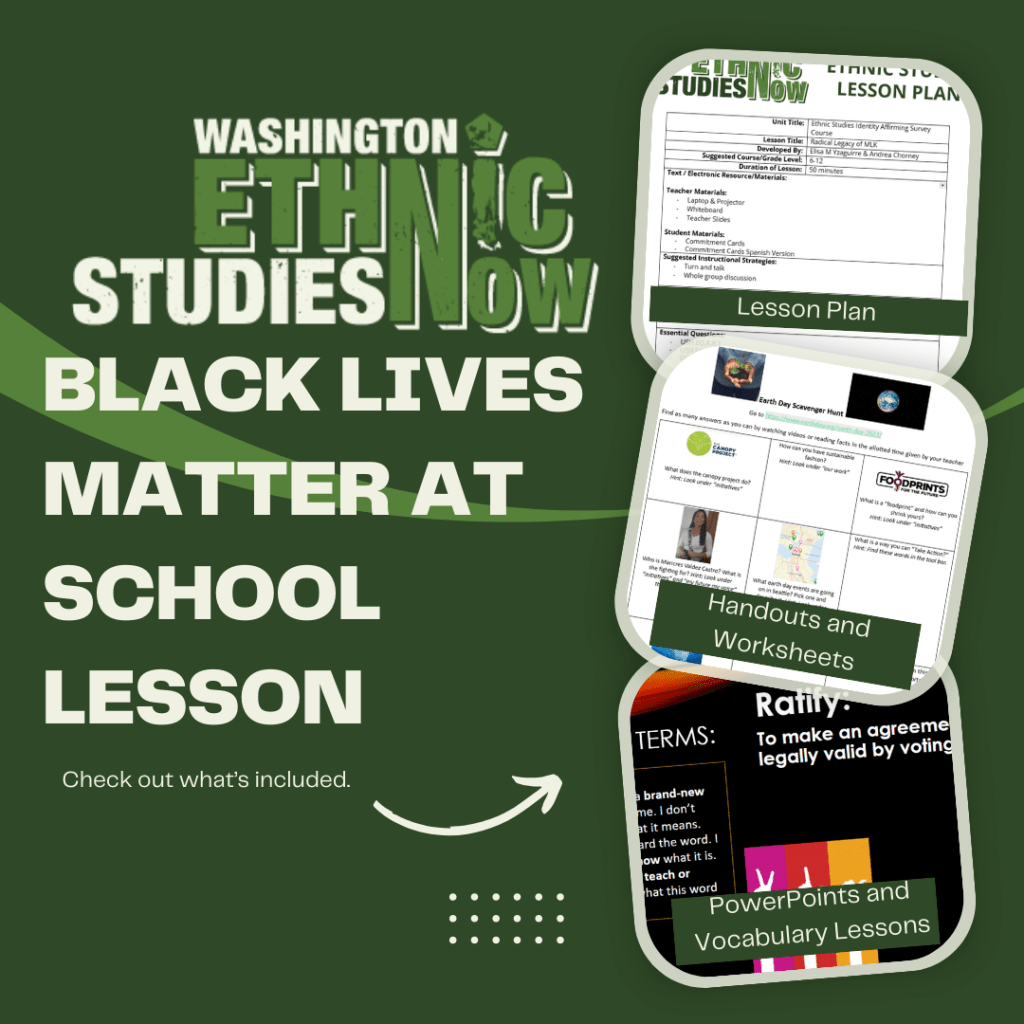
BLM at School Introduction provides students with a thoughtful, identity-affirming entry point into the Black Lives Matter at School movement. Grounded in Ethnic Studies and counter-narrative pedagogy, this two-part lesson centers history, principles, and lived experience—moving well beyond slogans or surface-level discussion.
Designed for grades 6–12, this lesson unfolds across two 50-minute class periods, allowing students time to engage deeply with content, discussion, and creative reflection. Students learn the origins and purpose of the Black Lives Matter at School movement and closely examine four of the thirteen guiding principles:
Black Villages, Collective Value, Queer Affirming, and Unapologetically Black (pages 1–3).
Through videos, vocabulary work, and structured turn-and-talks, students build shared understanding of key Ethnic Studies concepts such as collective, intersectionality, queer affirming, and Black joy (page 3). Students collaboratively define what community means to them, with the option to create a shared classroom or school-wide definition that can be displayed publicly (page 3).
In Part 2, students engage with counter-narratives through stories, media, and reflection—including learning about figures such as Martha P. Johnson, a Black transgender trailblazer (page 4). Students complete a creative worksheet that invites them to reflect on identity, joy, and what it means to show up as their true, unapologetic selves, using art, writing, and music as tools for expression (pages 4–5).
Educators are supported throughout with slide-based directions, multiple options for discussion or written response, and flexibility to adapt pacing and depth based on classroom context.
What’s Included
-
Two complete lesson plans (2 × 50 minutes) with clear pacing
-
Slide-based instruction with embedded educator guidance
-
Student worksheets for both lesson parts
-
Art-based and written reflection activities
-
Media analysis and discussion protocols
-
Alignment with WAESN Elements of Liberation, Washington State Social Studies Standards, and C3 Framework
Why Educators Use This Lesson
-
Introduces BLM at School with care, clarity, and depth
-
Centers Black joy alongside struggle and resistance
-
Affirms queer and trans identities without tokenization
-
Encourages student reflection without requiring disclosure
-
Minimal prep with strong instructional scaffolding
This lesson is ideal for educators seeking secondary Ethnic Studies curriculum that thoughtfully introduces Black Lives Matter at School, supports courageous conversation, and centers community, joy, and collective care—without relying on a heroes-and-holidays approach.