


Washington State Civics: Take Collective Action – Save Denny Blaine
Developed by: Oliver Miska
Suggested Course/Grade Level: 9–12
Duration of Lesson: 1–75 Minute Block + 3 Block Mini-Unit
Lesson Overview
The free Ethnic Studies resource, titled “Take Collective Action – Save Denny Blaine,” is lesson 9 of the Washington State Civics unit and is designed to empower students in grades 9 through 12 to strategize and implement civic advocacy campaigns through historical analysis and critical reflection.
Learning Goals
- Students will develop strategies for civic advocacy campaigns informed by historical analysis and critical reflection.
Case Study: Denny Blaine Park Advocacy
A central component of this lesson is the examination of the Denny Blaine Park case study, which serves as a real-world example of civic engagement and collective action.
Background
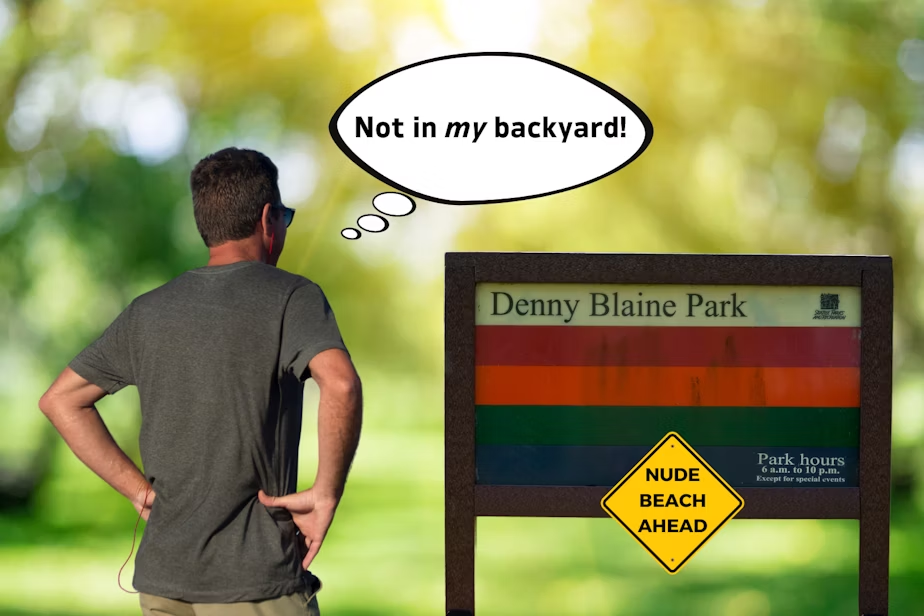
In late 2023, Seattle Parks and Recreation proposed the addition of a children’s play area at Denny Blaine Park, a site historically recognized for its clothing-optional beach and significance to the LGBTQIA+ community. The proposal was initiated by an anonymous donor, later identified as Stuart Sloan, a local businessman and adjacent property owner. Sloan had expressed concerns about the park’s nude sunbathers and sought to repurpose the space to discourage such activities.
The proposal prompted significant opposition from the community, particularly from LGBTQIA+ individuals who valued the park’s historical and cultural importance. Activists mobilized to “Save Denny Blaine Park,” organizing petitions, public meetings, and advocacy campaigns to preserve the park’s traditional use. A notable public meeting on December 6, 2023, saw an overflow crowd voicing near-unanimous opposition to the proposed changes.


In response to the community’s collective action, Seattle Parks and Recreation announced on December 8, 2023, that the proposed play area project would not proceed. The department acknowledged the feedback highlighting the park’s significance to the LGBTQIA+ community and the potential unintended consequences of altering its use. Plans were made to explore alternative locations for a play area and to engage further with community leaders to understand the park’s importance.
Application in the Classroom
This case study provides students with a tangible example of how collective action and civic advocacy can influence public policy and preserve community spaces. By analyzing the Denny Blaine Park scenario, students can identify key strategies used in successful advocacy campaigns, understand the importance of community engagement, and reflect on the role of historical and cultural contexts in civic issues.
Lesson Sequence
The lesson begins with an introduction to the Denny Blaine Park case study. The teacher provides students with the background of the proposed changes to the park and the subsequent community response. Using the Unit Slideshow, students are visually guided through the key events, including the motivations of the anonymous donor and the outcry from the community, particularly the LGBTQIA+ members who valued the park’s historical and cultural significance. This introduction sets the stage for deeper exploration of collective action.
Next, the class engages in a group discourse session to discuss the broader concepts of individual versus collective action. This discussion is designed to activate students’ prior knowledge and perspectives. The teacher facilitates by posing open-ended questions, encouraging students to connect their personal experiences or observations to the case study, and guiding them to formulate follow-up questions that deepen their analysis.


After the full-group discussion, students work in small groups to analyze various materials related to the Denny Blaine Park case. These materials include news articles, public statements, and meeting transcripts. Each group examines a specific aspect of the advocacy campaign, such as the strategies used to mobilize the community, the communication methods employed, or the impact of the campaign’s outcomes. The groups then prepare to share their insights with the rest of the class.
To expand on this analysis, students participate in a video jigsaw activity. Each group is assigned a different video segment that provides additional context, such as interviews with stakeholders or news coverage of the park proposal. After watching their assigned videos, students summarize their findings and share them during a class discussion, enabling the whole class to piece together a more comprehensive understanding of the campaign and its resolution.

The lesson then transitions into a full-group review of civic advocacy campaign components. Using the Denny Blaine Park case study as a reference, the teacher introduces the key elements of successful advocacy efforts, including setting clear goals, identifying stakeholders, crafting effective messaging, and planning actionable steps. This collaborative discussion provides students with a practical framework for organizing their own advocacy initiatives.
Finally, the teacher introduces the 3-lesson mini-unit expansion, which allows students to explore additional historical campaigns and compare them to the Denny Blaine Park example. This extension provides an opportunity to reinforce key concepts by examining how advocacy efforts in the past have shaped policy and community dynamics, drawing clear parallels to the students’ current learning experience.
By engaging with the Denny Blaine Park case study, students gain practical insights into the dynamics of civic advocacy and the impact of collective action. This lesson not only enhances their understanding of Washington State civics but also empowers them to become active participants in their communities.